Calculating the Return on Investment of Gifted Education

I was not a normal child. At age 2, my favorite pastime was disassembling every child safety device my parents bought. By age 4, I had become an avid user of the original Macintosh (despite being unable to read.) When I hit school, I was… ”impatient” with the pace of the curriculum. Luckily, I had great parents. They were interested enough to provide me with an endless supply of books and extracurricular excursions. They were savvy enough to maneuver me into an excellent charter middle school. And they were affluent enough to send me to a private high school where the teachers stuffed me with knowledge instead of letting the students stuff me into lockers.

Not all children are so lucky. I’m no social scientist, nor am I particularly well informed about the particulars of the American public educational system. What I am is strongly convinced that educational opportunities make an exceptional difference in the life of a gifted child. And that every gifted child in America – irrespective of background – deserves at least the same opportunities I had.

Last week, I read an article in the New York Times about the continued under-availability of gifted and talented (G&T) education, especially to minority students. In our era of unbelievably insane and misguided budget madness, education is something of an easy target. Children, of course, don’t vote. And G&T education is often seen as a luxury which can be cut or as a competitor for a fixed number of education dollars (especially against programs like special education.)

So, naturally, while falling asleep last night I decided to estimate the actual cost vs. benefit of gifted education. The results were somewhat surprising, so I’d like to share them with you.

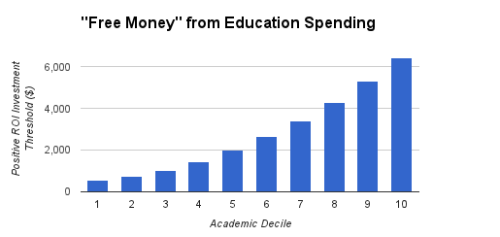
In short, the conclusion is that it literally costs the government $0 to spend up to $6,500 extra per pupil per year on gifted education. That’s approximately 50% more than the U.S.A. currently spends on the average pupil.

That sounds like a lot, right? Here’s how I got there:

First, we need a few simplifying assumptions:[1]

·      Students can be ranked into deciles by academic aptitude [2]

·      Annual income is related to academic aptitude by a power law distribution [3]

·      A well-targeted education program can raise the average annual income of a decile by 5% [4]

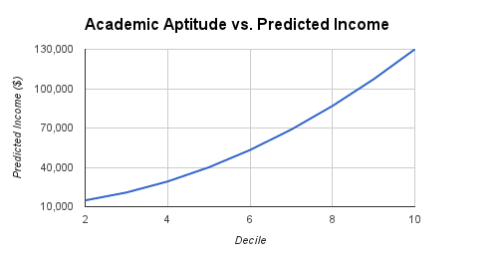
From there, the logic is simple. The annual median income for men in the USA is ~$45k [5]. We assume that the least a worker in the USA can make in a year is $10k [6]. We then roughly fit a power law distribution using income data reported by the U.S. Census Bureau (which has a pretty clear power law shape.)

(source)

This lets us predict annual income by academic decile:

From there, we can predict lifetime income by simply multiplying annual income by the average number of working years (assumed to be 43)[7]. We then multiply lifetime income by our education “bonus” multiplier (5%) to get the additional income each student is expected to generate over her lifetime. We then assume that the government will take back 30% of that extra income through taxes. We divide those collections by the number of years a student spends in school (13), and we have our annualized “free money” threshold, i.e. an amount of spending per pupil that will generate a positive return on investment for the government.[8]

This chart shows the conclusion:

If you’d like to see the calculations step-by-step or you’d like to adjust my assumptions, take a look at this Google doc.

What does this chart say, exactly? It says that if the government spends an additional $5,000 per year on a gifted student, it can expect to collect more back in income taxes over her life than it spent on her gifted education. In other words, up to a point (i.e. $6,500) spending on gifted education is literally free for the government.

That means that any debate about prioritizing gifted vs. special needs education is deeply misguided. It’s not an either/or question. The only reasonable course of action is to just spend the money on gifted education and make all other education spending decisions independently. The government need not even raise taxes to fund the programs; they could issue a 30-year municipal bond and expect to be able to pay back the interest with the extra taxes they collect.

Now this analysis is obviously an oversimplification. Everyone knows that being smart per se does not guarantee a high income.[9] It’s crude at best to assume a static and binary 5% boost in income from simply having a gifted program. And this analysis completely ignores the many social benefits of having better prepared doctors and scientists[10]. I discuss a number of other specific flaws in the footnotes.

Nevertheless, I think the conclusion is sound. Opportunities for accelerated education made a huge difference in my life, and it’s a tragedy that talented students continue to be denied those opportunities just because of their parents’ income. Whether the USA recognizes that fact, China and India certainly will.

Notes:

[1] Relevant data was hard to find on a cursory Google search. If you have better data or feel like making more sophisticated models, please post in the comments!

[2] The idea of innate academic aptitude is controversial enough even without specifying a yardstick. So choose your own! The method of measurement doesn’t affect the logic as long as a measurement can be made.

[3] It’s pretty clear that income itself follows a power law distribution. I’ve never seen a good study about how well academic aptitude predicts income, but to whatever extent America actually is a meritocracy: it will. For every maxim about “A students work for C students”, I’ve met very few unintelligent people who’ve earned large amounts of money.

[4] I pulled this number out of a hat. Intuitively and based on my own experience, I suspect it’s significantly higher. But I wanted to be conservative for the analysis.

[5] The median income for women is substantially lower, but I’m assuming that’s because homemakers are counted. Assuming men and women have equal earning potential if they actually do work, using male income shouldn’t affect the conclusion.

[6] A bit less than full-time minimum wage income, since unemployment rates are much higher for the less educated.  http://poverty.ucdavis.edu/faq/what-are-annual-earnings-full-time-minimum-wage-worker

[7] Working from 22-65

[8] I’m ignoring any time-value-of-money issues, both because that would be complicated and because I figure that wages should grow approximately at the interest rate, so discounting vs. wage inflation should cancel out.

[9] In an era where a good data scientist can earn $300,000…we’re getting close. Many top decile people will chose lower income careers, but they will have had at least the option to earn more if they chose.

[10] Medical, technological, and scientific discovery probably also follow a power law distribution. So we should expect that giving our brightest scientists more education will significantly increase the rate of discovery.

You’re Doing Freemium Wrong

I make a point of trying as many new startup products as I reasonably can. Quite a lot use a freemium model where they offer me some free service and then pester me to upgrade to the $10/month “pro” version. Out of dozens of products I’ve tried over the last couple of years, I’ve upgraded to the pro version approximately three times (Dropbox, Github, Spotify.)

 Why so few? Sometimes the product is just bad. Sometimes it’s targeted at a real problem I don’t have. But in a surprising number of cases, I’m not upgrading because the startup is using a freemium model that just doesn’t make sense.

My basic contention in this post is that in many freemium startups, the free product is the real product and the “pro” product is just a bunch of random tacked-on features that might appeal to power users. Instead, startups should remember that the premium product is the real product, and the free version is just a conduit to make people aware that paying money will actually solve their problem.

Now I’ve never managed a freemium model myself, so these are just common sense observations. I may be missing the deep inner logic of particular programs are particular startups. But in too many cases, it’s mighty hard to imagine how what I’m seeing could make sense.

The Wrong Way:

Let’s start with some basic logic:

1)   Your startup is in business to make as much money as possible [1]

2)   The amount of money you make equals (the number of people paying you, i.e. your customers) X ($ per customer)

3)   To maximize your revenue, you need to simultaneously maximize your # of customers and your $/customer

So far, so good. But let’s pause for one crucial point. Only people who pay you are customers. Everyone else, including non-paying users of your service, are not customers. That’s not to say they aren’t lovely people, or that they may not serve a critical business purpose like word-of-mouth marketing or generating content, but they don’t pay you and so they are not customers.

Now the logic behind the freemium model is:

4)   We will offer a free service and a premium service (for $X)

5)   Some % of users will be willing to pay $X to become premium users  (i.e. customers)

6)   So we need to acquire as many free users as possible to maximize our # of customers and therefore our revenues.

Sound reasonable? No!

There’s a gaping logic hole between #5 and #6, and it swallows many startups.

Sarlac

(Artist’s rendition of a logic hole)

The problem is the assumption that you’ll be able to convert a constant % of users into customers. 

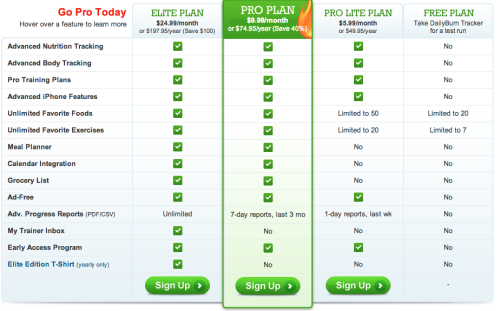
Let’s say you’re a fitness tracking app, for example DailyBurn (which I use)[2]. You launch your core product, a calorie and workout tracker. It’s free to use, and after a month you’ve got 10k users. Great! But you’re running a bit low on cash, so you decide to get started on the “mium” part, and you launch a set of “pro" features like the ability to save more favorite foods and to plan meals in advance:

Daily burn pro options

Five hundred users (5%) sign up for the $10/month pro plan, and suddenly you’re making $5k a month in revenue. Not only can keep your servers on, you can also afford some calories for yourself to track.

$5k/month is great, you think, but this means that if I had 10 million users then I’d have 500,000 customers and I’d be making $5 million dollars a month!

Of course, this story very rarely ends well. The startup devotes all of its resources into improving and marketing its core free product, and (in the good case) actually gets a large number of free users. But the more users they acquire, the lower the conversion percentage dips. Suddenly the startup is facing titanic operating costs, all shouldered by a relatively tiny number of actual customers.

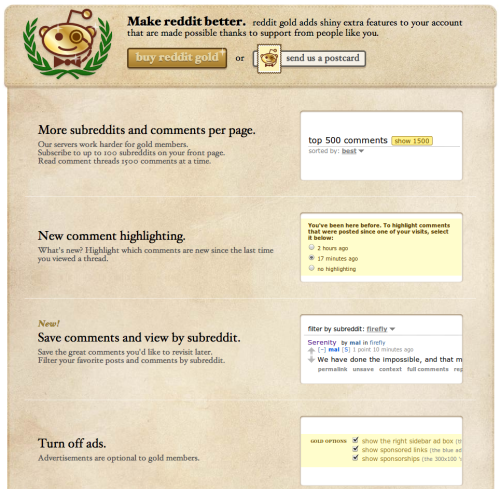
The best example of this trap is a product I use more than I would like to: Reddit. In 2012, Reddit had 32 billion page views. But according to the best numbers I could find (which are admittedly very dated) their premium offering (“Reddit Gold”) attracts less than .1% of users [3][4] When you take a look at what Reddit gold offers, it’s not hard to see why:

Reddit gold

If I pay Reddit $3/month, I can turn off (unobtrusive) ads and… save and highlight comments?

The Reddit and DailyBurn premium programs have one key thing in common: they’re a set of (basically random) tacked on features that only appeal to the most power of power users. Both of the core products solve a clear and urgent need (how do I lose weight, and how do I find cat pictures). But the premium products solve a minor problem for a small minority of users.

And that explains the diminishing returns to scale: not only are 97% of your users never going to care about saving comments, but even worse – the people who are most likely to become super-power users are also most likely to be early adopters. So if you design your premium program to only appeal to power users, you should expect that conversion rates will drop with each new cohort of increasingly unsophisticated users.

If you ignore that fact, you may very quickly find yourself learning the old economic truism that “anyone can sell a dollar for 99 cents.

The Right Way:

What’s the alternative? From day one, you should think of your free product as a way to foster addiction to your premium product, ideally by creating a behavior pattern that will naturally and inevitably lead to needing premium-only features. Your free product should make your user aware of two things:

1)   You have a burning need

2)   I have a way to actually solve it if you give me some money

If you stop thinking in terms of free vs. premium and starting thinking in terms of “problem understood” vs. “problem solved”, you’ll find it much easier to actually drive up conversions and turn users into customers instead of costs. Which is the whole point of your business.

The best example I know of freemium done right is Amazon’s AWS.  I bet you can immediately recall AWS’s de facto tagline “a great, cheap way to start a company with no upfront capital costs.” Amazon has pushed that message very hard and very effectively. But here’s the problem: AWS is actually not cheap. It’s only cheap AT FIRST.

Amazon offers a “free tier” that lets you spin up a few virtual machines with a little bit of storage (about enough to host a low traffic blog), all for free. This encourages users to familiarize themselves with the service, and that experience makes it easy for them to image how awesome it would be to run a entire serious startup on AWS.  Many startups, including mine, do exactly that.

But once you’re a few months in and you’ve added a few more instances and a database, the bills suddenly jump. And you very quickly notice that running a more powerful EC2 instance for a year is about 5-10x more expensive than just buying a comparable machine. And storage on EC2 (which you’re probably going to need for that database) costs $0.10/GB/MONTH! You can buy a 1TB hard-drive for what it costs to host 1TB of data on EC2 for one month.

From my perspective as the guy writing the checks, this model is painful. But from Amazon’s perspective it’s brilliant. By the time I actually experience the real cost of using AWS it’s far too late for me to switch. I’m addicted.

And to add insult to injury, AWS cuts off the free tier after one year of usage. They figure that after a year you’ve probably already told all your friends about AWS, and if by then you still haven’t gotten addicted then you’re probably never going to. So there’s no reason to continue to subsidize your use.

The other freemium products I pay for work the same way: anyone who has 5GB of stuff to store in Dropbox will pretty soon generate a sixth GB; if you start storing all your code in Github, eventually you’ll want to keep some of it private; if you replace iTunes with Spotify, eventually you’ll want to listen to music on your iPhone and need premium.

Conclusion:

There are plenty of perfectly good reasons to want a lot of permanent free users. They’ll tell their friends, and as Fred Wilson points out you can show advertising. They may even generate the content that brings people to your site. But with a $2 CPM, you’ll make about as much from 5000 users paying $100/year as you would from two hundred fifty million ad impressions. 

At the very beginning of a startup, it would be foolish to focus excessively on exact monetization strategies before you’ve demonstrated that you can create monetizable value. And many businesses have started with free and then found pockets of value they could charge for. Nevertheless, a little thought at the beginning can go a long way. Especially if you’re addressing a niche market, it makes a lot more sense to drive up your conversion rates by designing your free product to addict customers to paying you.

Normal
0

false
false
false

EN-US
JA
X-NONE

/* Style Definitions */
table.MsoNormalTable
{mso-style-name:”Table Normal”;
mso-tstyle-rowband-size:0;
mso-tstyle-colband-size:0;
mso-style-noshow:yes;
mso-style-priority:99;
mso-style-parent:””;
mso-padding-alt:0in 5.4pt 0in 5.4pt;
mso-para-margin:0in;
mso-para-margin-bottom:.0001pt;
mso-pagination:widow-orphan;
font-size:12.0pt;
font-family:Cambria;
mso-ascii-font-family:Cambria;
mso-ascii-theme-font:minor-latin;
mso-hansi-font-family:Cambria;
mso-hansi-theme-font:minor-latin;}

[1] Obviously subject to ethical and other constraints

[2] Although DailyBurn is not nearly the most egregious freemium offender, I picked them as an example because a) I actually use them but never see myself upgrading and b) they’ve pivoted to become a protein powder company, which I’m assuming means their freemium model did not work as hoped.

[3] http://techcrunch.com/2010/07/13/reddit-gold-update/

[4] Of course Reddit also monetizes through advertising

My Top 40 Albums of 2012

(With Spotify playlist! Click: Best Albums 2012)

LIST:

40       Blunderbuss – Jack White

39       Open Your Heart – The Men

38       Trouble – Total Enormous Extinct Dinosaurs

37       Lion’s Roar – First Aid Kit

36       Centipede Hz – Animal Collective

35       Mature Themes – Ariel Pink

34       Oshin – DIIV

33       Port of Morrow – The Shins

32       Life is Good – Nas

31       Put Your Back N 2 It – Perfume Genius

30       Sweet Heart, Sweet Light – Spiritualized

29       Bloom – Beach House

28       Channel Orange – Frank Ocean

27       The Haunted Man – Bat for Lashes

26       XXX – Danny Brown

25       Lonerism – Tame Impala

24       Drop Gloss – Battles

23       Kill For Love – Chromatics

22       Putrifiers II – Thee Oh Sees

21       III – Crystal Castles

20       Slaughterhouse – Ty Segall Band

19       Allah-Las – Allah-Las

18       Orbits – Starkey

17       Fear Fun – Father John Misty

16       Swing Lo Magellan – Dirty Projectors

15       Bend Beyond – Woods

14       Shields – Grizzly Bear

13       End of Daze EP – Dum Dum Girls

12       Sun – Cat Power

11       Good kid, m.A.A.d City – Kendrick Lamar

10       Get Disowned – Hop Along

9     Ugly – Screaming Females

8     I Bet on Sky – Dinosaur Jr

7     R.A.P. Music – Killer Mike

6     Devotion – Jessie Ware

5     Transcendental Youth – the Mountain Goats

4     Something – Chairlift

3     Yellow & Green – Baroness

2     Attack on Memory – Cloud Nothings

1     Celebration Rock – Japandroids

Worst Album of the Year: The Money Store – Death Grips

The Simple Reason Twitter Will Win the Sharing War…

…is that most of what people share is terrible. That picture of Fluffy might be meaningful to my random college friend Jim, but it’s boring to me. 

I am extremely skeptical of “Zuckerberg’s law” (i.e. that the amount people share will double every year) because I just don’t believe that my life (or yours) generates that quantity of interesting content.

Now there are certainly plenty of great things being shared; almost every day I read an article or listen to a song recommended by a friend. But an unscientific poll of my Facebook feed shows that as much as I do care about my friends, I’m only interested in what they share at best 25% of the time. Google+ (where I maintain an account out of morbid curiosity) is even worse. Visiting either site has become for me an exercise in flicking the scroll wheel and hoping that something interesting will pop out of the literal blur of long status updates and giant filtered photos.[1]

My experience with Twitter is completely different. I follow nearly 200 people, but I read (or at least skim) every tweet.

What’s different?

1)   The “follow” relationship on Twitter is fundamentally different. “Follow” expresses “I am interested in what you have to share,” and nothing else. So my Twitter feed is pre-filtered. 

2)   In most cases, a tweet is not a share per se[2] but rather a bid for attention. Yes, some tweets bask in triviality.But most of the time, you get 140 characters to explain to me why I should click your link. Most bids fail; Buffer has shown me that my followers click only about 10% of my links. While it’s frustrating that you all aren’t more interested in spider helicopters or  how to build a Hadoop/Hbase cluster in an hour, it’s great that you get to very quickly move on.

So far, Twitter is the only sharing service I’ve seen that respects my time. Attention is only going to get scarcer as science develops more and more dancing robots.

The service that maximizes information per unit attention is going to win.[3]

[1] An obvious objection is that many people read Facebook for entertainment rather than information. But there are better sources of entertainment.

[2] Grammar nerd pet peeve alert! “Per se” is Latin for “through itself,” not for “exactly”. So this is the correct usage.

[3] At least at feed-style sharing. We’re going to start seeing interesting data magic with the aggregate data about viewing/sharing behavior.

The Only Way To Create Political Change: A Step-by-Step Guide

I’m fortunate to have a lot of well-intentioned friends. They believe in a variety of noble causes and sincerely want to change the world for the better. To date, few of them have succeeded. [1]

With the terrible tragedy on Friday, we’ve seen an outpouring of good intentions on Facebook and Twitter. But I’d be very surprised if that sentiment produces any more meaningful change than all the similar outpourings following (far too many) previous tragedies.

Why? Because every failed movement fails in its own way, but every successful movement is alike.

There is really only essentially one way to create meaningful political change. I’m going to walk you through it now.

Step 1: Identify the decision-makers.

The USA is a democratic republic (not a democracy.) We have a legislature that makes laws, an executive that enforces laws and controls administrative agencies, and a judicial system that interprets the law and the constitution.

Nearly every aspect of our society is under the direct control of one of those branches (or its local equivalent) and no one else.  If you want to change the law (for example to ban assault weapons), you must win over 51% of the legislature. [2]

Win over 51% of the legislature and you win. Win over 50% or less and you lose, no matter how much money you raised or awareness you created. It really is that simple.

Step 2: Identify your opponents.

The status quo is not random. Whatever aspect of society you identify as a bug, someone else sees as a feature. That person (or more often, that very large group of people) prefers things they way they are and will actively fight change. Sometimes, your opponent really will be a shadowy cabal of corporate SuperPAC’s. But in most cases your opponents will be an outright majority of your fellow citizens.  In that case, you have very different problems that require very different tactics.

Step 3: Figure out how to sway the decision maker.

For example, let’s assume that you’re trying to pass a law; 51% of Americans oppose it; Congress voted down the law 41%/59% last year.

What are you to do? Since you’ve completed Steps 1&2, you already know that you need to pick up the votes of 10% of Congress, and that there is a large and organized group of citizens who are pushing Congress the other way.

What determines how a Congressman votes? A little bit of ideology and a whole lot of fear about reelection.

So you need to convince 10% of Congress that flipping to your side is the best way (or better yet the only way) to get reelected. You do that by identifying the Congressmen who won their last election by the smallest margins, preferably in districts where overall public opinion on your issue is as favorable as possible.

Step 4: Create a credible (political) threat.

Politics is the art of threatening with a smile. And now you know exactly which Congressmen to threaten.

You’re not going to be able to bluff this part. Politicians are incredibly savvy at reading the political winds, and if you’re just blowing air there is going to be a large opposition actively pointing that out.

You’re going to need to actually change a lot of hearts and minds, and make your target Congressmen painfully aware of that change. To do that, you’re going to need to get organized. You need to build an actual organization (with leaders and resources) that contacts citizens, convinces them, and commits them to expressing their newfound view directly to their representative.  This effort has to be strategic. Getting a million New Yorkers to sign a petition for more mass transit funding is completely useless if the relevant bill is being filibustered by a senator from Idaho.

Step 5: Enjoy

If you follow these steps, one of two things will happen. Either you’ll realize that enough people disagree vehemently with your goals that you’ll never get what you want no matter what tactics you use. Or you’ll actually get to watch a law be passed that finally corrects a serious social blight.

This year’s successful war against SOPA is an excellent example of this method in action. That effort worked because the major tech organizations united in opposition to the law (which was already unpopular among those who knew about it), they put their message clearly in front of millions of voters, and they coordinated an outpouring of calls and letters to Congressmen. That groundswell made enough Congressmen realize that supporting SOPA threatened their own reelection, and the law collapsed.

I trust that my friends will remain well intentioned. And I look forward to all the wonderful things they’ll accomplish if they just remember: identify the decision makers, identify your opponents, figure out how to sway the decision makers, and create a credible political threat by contacting, convincing, and committing the right group of fellow citizens.

[1] Except perhaps on a very local scale, which is valuable but much less than they intended.

[2] Or 61%, thanks to our silly filibuster system.